
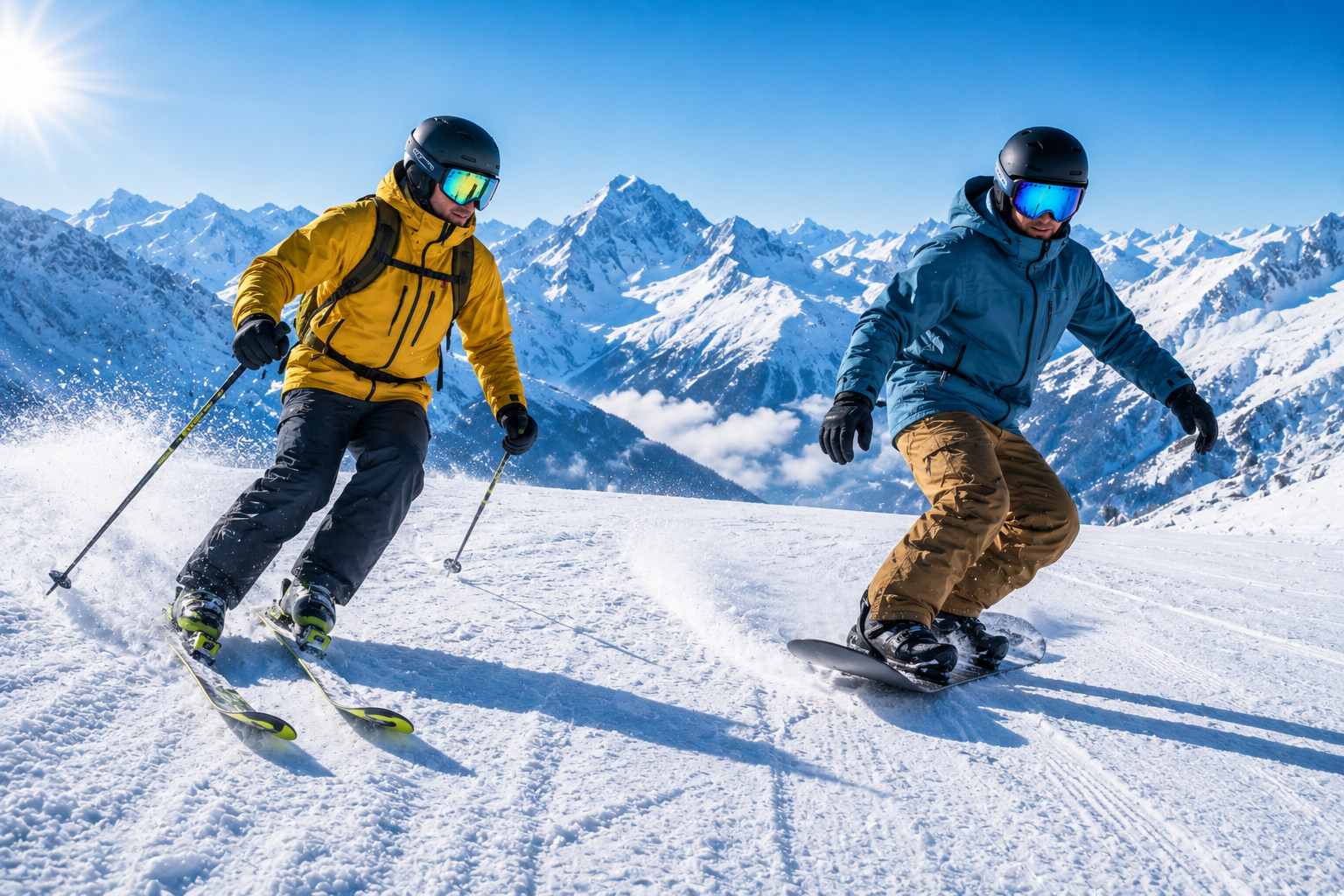
Skiing vs. Snowboarding: Key Differences in Movement, Gear, and Learning Experience
For many people planning their first snow trip, one question comes up quickly: Should I try skiing or snowboarding?
Both sports take you onto the same mountain, through the same cold air, fresh snow, lift rides, falls, laughter, and unforgettable winter moments. But the way they feel is very different. Skiing and snowboarding use different body positions, different gear, different learning curves, and even different kinds of confidence.
Neither one is simply “better.” The right choice depends on how you like to move, how patient you are with the learning process, what kind of experience you want, and what makes you feel more comfortable on the snow.
1. Body Position: Facing Forward vs. Sideways
The biggest difference between skiing and snowboarding starts with body position.
In skiing, your body faces forward. Each foot is attached to its own ski, and your legs move independently. This feels more natural for many beginners because it is closer to walking, running, or skating. You face the direction you are going, and you can use ski poles to help with balance and movement on flat areas.
In snowboarding, both feet are attached to one board, and your body stands sideways. You move down the slope with one shoulder leading, which can feel strange at first. Beginners often need time to get used to turning their head, shoulders, hips, and board together. Because both feet are fixed to the same board, losing balance can feel more dramatic in the beginning.
That is why skiing often feels easier to start, while snowboarding may feel awkward during the first few hours.
2. Balance and Movement
Skiing gives beginners more independent control. Since each leg can move separately, you can adjust your stance, slow down, or recover balance more easily. The classic beginner “pizza” or wedge position helps control speed and makes the first learning stage feel more manageable.
Snowboarding depends more on edge control. You use either the heel edge or toe edge of the board to slow down, turn, and stop. This means beginners must learn how to shift weight carefully. Too much pressure on the wrong edge can lead to a sudden fall.
For this reason, snowboarding beginners often fall more frequently at the start. Many falls happen backward onto the hips and tailbone, or forward onto the knees and wrists.
This is also where additional cushioning can make a noticeable difference during the learning stage. Padded shorts can add a protective layer around the hips and tailbone, while knee pads can provide extra cushioning when your knees contact hard-packed snow.
Our Padded Shorts collection includes options using EVA or foam cushioning, breathable materials, adjustable fits, and coverage around common impact areas, while our Knee Pads collection includes flexible and padded options that can sit underneath suitable snow clothing.
If repeated falls are making you tense or hesitant, these smaller protective layers can help make practice feel more manageable without replacing proper technique or safety awareness.
Once a snowboarder understands edge control, however, progress can feel faster and smoother.
3. Learning Curve: Which One Is Easier?
A common saying is:
Skiing is easier to learn, but harder to master. Snowboarding is harder to learn, but often easier to progress once the basics click.
For skiing, the first day can feel more accessible. Many beginners can learn basic stopping and gentle turns relatively quickly. Because the forward-facing position feels familiar, skiing may feel less intimidating at the start.
But as skiers progress, technique becomes more complex. Parallel turns, carving, moguls, powder, steeper slopes, and advanced control require strong coordination between both legs.
Snowboarding can be frustrating in the beginning. The first day may involve many falls, especially while learning to stand up, stop, and control edges.
That makes comfort particularly important. When your hips, tailbone, or knees become sore after repeated falls, it can become harder to relax and commit to the next movement. Adding padded protection underneath your snowboard clothing can help reduce some of that discomfort and let you focus more on learning the movement itself.
But once turning starts to feel natural, many snowboarders progress quickly. The movement becomes more fluid, and the sport often feels very expressive and free.
4. Gear Differences
Skiing and snowboarding require different main equipment.
Skiing Gear
Skiers use:
- Two skis
- Ski boots
- Ski poles
- Ski bindings
- Helmet
- Goggles
- Gloves
- Ski clothing
- Optional protective gear
Ski boots are usually stiff and supportive. They help transfer movement from the legs into the skis, but they can feel uncomfortable for beginners when walking around the resort.
Ski poles help with balance, rhythm, and movement on flat areas. They are especially useful when pushing across gentle terrain or getting into position before a run.
Goggles are another important part of the setup because skiing constantly exposes your eyes to cold wind, blowing snow, reflected light, and changing mountain conditions.
A good pair of goggles should not simply cover your eyes. The fit, field of view, ventilation, and lens setup can all affect how comfortably you see the terrain ahead.
Our Ski Goggles collection includes options with features such as anti-fog lenses, wind protection, wide-view formats, adjustable straps, double-layer lenses, and UV400 lens options.
For a beginner, reducing fogging, wind exposure, and visual distraction can make it easier to focus on speed, turns, other riders, and changes in the slope.
Snowboarding Gear
Snowboarders use:
- One snowboard
- Snowboard boots
- Snowboard bindings
- Helmet
- Goggles
- Gloves
- Snowboard clothing
- Protective gear such as wrist guards, knee guards, and padded shorts
Snowboard boots are usually softer and more comfortable to walk in than ski boots. However, snowboarders often need to sit down to strap in, especially when getting off the lift or preparing for a run.
That repeated sitting, kneeling, and standing is one reason lower-body comfort matters so much.
Padded shorts can add cushioning around the hips and tailbone while remaining underneath your outer snow pants. Knee pads can help when you spend time kneeling to adjust bindings or repeatedly contact the snow during practice.
Because these layers sit underneath your outer clothing, they can become part of your normal snowboard setup rather than feeling like separate bulky equipment.
Snowboarding does not use poles, which gives the sport a more minimal and free feeling, but it also means flat areas can be harder to move across.
5. Protective Gear Needs
Both skiing and snowboarding require protection, but the common fall patterns are different.
Skiers often worry about knee strain, twisting falls, and losing balance while turning or stopping. A helmet, goggles, gloves, and proper ski clothing are important parts of a responsible setup. Some skiers also use knee support or padded shorts for added comfort.
If you find that your knees frequently make contact with the snow, our Knee Pads include options with flexible compression construction, EVA foam or sponge cushioning, and adjustable or pull-on fits. These types of features can add cushioning without necessarily preventing normal knee movement.
Snowboarders tend to fall more often on the wrists, tailbone, hips, and knees, especially during the beginner stage. This makes protective gear particularly relevant for new snowboarders.
Useful snowboard protection includes:
- Padded shorts for hips and tailbone
- Wrist guards
- Knee guards
- Helmet
- Gloves with good palm protection
- Face covering for cold and wind
For the hips and tailbone, our Padded Shorts collection includes options with EVA, foam, breathable mesh, stretch materials, adjustable fits, and coverage intended for snow-sports impact areas.
That combination matters because protection still has to work with movement. Padding that feels excessively bulky can become distracting, while a more flexible layer can sit underneath your snowboard pants and move with you as you bend, sit, and stand.
Protection does not remove all risk, but it can help beginners feel more confident. When you are less afraid of every fall, you are more willing to practice, stand up, and keep going.
6. Clothing Differences
Ski clothing and snowboard clothing have many similarities, but the style and fit can differ.
Ski clothing is often more fitted and streamlined. Skiers usually need mobility, warmth, weather coverage, and breathability without too much unnecessary bulk.
Our Ski Jacket collection includes different options featuring combinations of waterproof or wind-resistant shells, insulation, breathable constructions, hoods, snow coverage, and useful pocket configurations.
This makes a separate jacket useful for skiers who want to control their layering more precisely. You can change what you wear underneath according to temperature without replacing your entire outer setup.
Ski pants have a different job. Your knees are constantly bending, your legs are shifting weight, and you may be wearing thermal underwear or protective padding underneath.
Our Ski Pants collection includes waterproof, windproof, fleece-lined, stretch, loose-fit, slim-fit, and suspender-style options, giving you different ways to balance weather protection, warmth, fit, and room for additional layers.
For skiers who prefer to choose the upper and lower parts separately, this flexibility makes it easier to build a setup around your body shape and preferred layering system.
Snowboard clothing is often looser, especially in pants and jackets. This gives riders more room for bending, twisting, sitting, strapping in, and freestyle movements.
Snowboarders may also spend more time sitting or kneeling on snow, so outer pants with room for thermal layers and padded protection can be especially practical.
A snowboarder might combine:
Thermal base layer → Padded shorts or knee protection → Snow pants
That allows warmth and cushioning to work together without requiring one excessively heavy piece of clothing.
Layering Matters for Both Sports
For both sports, the most important clothing system is layering:
Base layer: helps manage sweat
Mid layer: adds warmth
Outer layer: protects against wind, snow, and moisture
The base layer is easy to underestimate because nobody sees it once you are dressed, but it can have a major influence on comfort.
Our Thermal Underwear collection includes quick-dry, moisture-wicking, breathable, fleece-lined, seamless, and high-stretch options.
These features are useful because skiing and snowboarding alternate between high activity and long periods of lower activity. You may build heat while riding and then sit almost still on a cold lift a few minutes later.
A thermal layer that moves closely with your body can add warmth without requiring as much bulk underneath your outer clothing.
The right clothing helps make the day more enjoyable. If you are cold, wet, or restricted, it becomes harder to focus on learning and having fun.
What About a One-Piece Ski Suit?
A jacket-and-pants combination is not the only option.
If you prefer fewer separate outerwear pieces, a ski jumpsuit gives you one-piece coverage across the upper and lower body.
Our Jumpsuit collection includes options featuring combinations of waterproof and windproof coverage, insulation, breathable construction, stretch, and one-piece snow coverage.
A jumpsuit can be particularly appealing if you want:
- One-piece outer coverage
- Fewer garments to coordinate
- Easy layering over thermal underwear
- Less separation between your jacket and pants
- A straightforward outfit for a full ski day
For beginners preparing for a trip, the simplicity of one main outer layer can also make packing and getting dressed easier.
7. Lift Experience
Getting on and off lifts can feel different for skiers and snowboarders.
Skiers usually keep both skis on and use poles for balance. Getting off the lift can feel a little nervous at first, but many beginners adapt quickly because both feet can move independently.
Snowboarders usually ride the lift with one foot strapped in and one foot free. Getting off the lift requires gliding with one foot attached, which can feel awkward for beginners. Many first-time snowboarders find lift exits challenging until they develop better balance and confidence.
This is one reason snowboarding can feel harder at the beginning, even before the actual downhill riding starts.
It is also another reason snowboarders may appreciate padded shorts. Lift exits are one of those moments where a beginner can suddenly lose balance and land backward, and extra cushioning around the hips and tailbone can make those early mistakes feel less punishing.
8. Flat Terrain and Resort Movement
Skiers generally move more easily on flat terrain. With poles and two separate skis, they can push themselves forward, skate, or glide across gentle areas.
Snowboarders have a harder time on flat ground. Because both feet are usually attached to one board during riding, moving across flat areas can require unstrapping one foot and pushing, almost like using a skateboard. This can be tiring, especially for beginners.
If a resort has many flat sections, skiing may feel more convenient. Snowboarders often prefer terrain with consistent downhill flow.
Whatever you choose, this extra movement means clothing should not feel restrictive.
Thermal layers with stretch, ski pants with enough room for bending, and outerwear that allows natural movement can make walking through the resort, adjusting equipment, and getting back onto the slope more comfortable.
9. Style and Feeling
Skiing often feels controlled, direct, and precise. Because each ski moves separately, skiers can make quick adjustments, carve clean turns, and handle a wide variety of terrain with technical control.
Snowboarding often feels more surf-like and flowing. The sideways stance, single board, and carving motion can feel smooth and expressive once learned. Many snowboarders love the feeling of rhythm, body movement, and freedom that comes when turns finally connect.
This difference is one reason people feel emotionally drawn to one sport over the other. Skiing may feel more natural and stable. Snowboarding may feel more creative and loose.
Your clothing can reflect that difference too.
If you prefer a cleaner, more modular setup, combining a ski jacket and ski pants lets you adjust the upper and lower fit separately.
If you prefer a more unified silhouette and fewer separate outerwear pieces, a ski jumpsuit offers another approach.
The best choice is not simply the one that looks better standing indoors. It is the one that still feels comfortable when you bend, turn, sit, layer, fall, and spend an entire day outside.
10. Which One Is Better for Beginners?
If you want the easier first-day experience, skiing may feel more approachable. The forward-facing stance, independent leg movement, and use of poles can make the beginning feel less intimidating.
A beginner ski setup can stay relatively straightforward: thermal base layers, suitable ski outerwear, goggles, gloves, helmet, and any additional protection you personally find useful.
If you are patient with a harder start and like the idea of a sideways, board-based movement, snowboarding may be very rewarding.
Because early snowboard sessions often include more sitting, kneeling, and backward falls, padded shorts and knee protection may deserve a higher place on your equipment list.
A simple way to choose:
Choose skiing if you want:
- A more natural starting position
- Easier movement on flat terrain
- Faster early control
- A forward-facing riding style
- More independent leg movement
For your clothing setup, consider combining Thermal Underwear + Ski Jacket + Ski Pants, or choose a Ski Jumpsuit if you prefer one-piece outer coverage.
Choose snowboarding if you want:
- A surf-like, flowing feeling
- A more freestyle-oriented style
- Softer boots
- A stronger board-sport experience
- A challenge that may feel awkward first but rewarding later
For your setup, consider giving extra attention to Padded Shorts, Knee Pads, Goggles, Thermal Underwear, and outerwear that gives you enough room to bend, sit, twist, and move freely.
You do not need every product at once. Start with the pieces that solve the problems you are most likely to encounter.
If cold is your biggest concern, begin with your layering system.
If visibility bothers you, focus on goggles.
If repeated falls are making snowboarding uncomfortable, consider padded shorts and knee protection.
If you want flexible outerwear, choose separate jackets and pants.
If you prefer a simpler one-piece approach, consider a jumpsuit.
Final Thoughts: Different Paths to the Same Mountain Feeling
Skiing and snowboarding are different in movement, gear, learning experience, and the way they make your body feel on the snow.
Skiing often gives beginners a more familiar start, while snowboarding may demand more patience in the beginning.
Skiers use two skis and poles; snowboarders ride one board with both feet fixed.
Skiing can feel precise and stable, while snowboarding can feel flowing and expressive.
But in the end, both sports lead to the same thing: time outside, cold air, mountain views, funny falls, small breakthroughs, and memories that stay with you long after the snow day ends.
Whether you choose skis or a snowboard, the real goal is not to look perfect on the first run.
It is to understand what your body needs, choose gear that supports the way you move, and remove as many unnecessary distractions as possible.
Warm thermal layers help you manage cold conditions.
The right outerwear gives you room to move while providing snow and weather coverage.
Goggles help reduce wind, snow, glare, and fog-related distraction.
Padded shorts and knee pads can add cushioning where beginner snowboarders often make contact with the ground.
Once those basics feel right, you can spend less time thinking about what you are wearing and more time learning what the mountain actually feels like.
The goal is to feel prepared enough to begin, protected enough to keep going, and comfortable enough to discover whether skiing or snowboarding is the sport that makes you want to come back for another run.